
This afternoon I am meeting Kees. I hop onto my electric bicycle and make my way to the elegant Rotterdam district of Kralingen, where Kees van der Mark lives. Upon arrival, I am warmly welcomed by Kees and his friend Emiel van der Maaten and invited into the trophy room.
Alongside numerous African trophies, I notice a pair of impressive red deer antlers, a magnificent sika stag, several roe deer trophies, wild boar tusks and a mounted fallow deer. It is hard to imagine a more fitting setting in which to hear about their remarkable South African adventure.
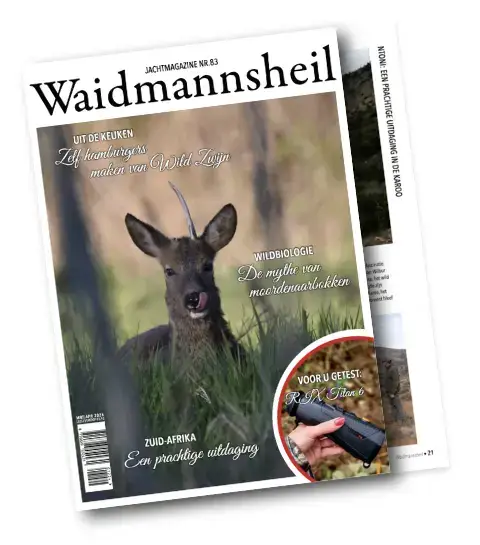
Prefer reading this story in the magazine? Waidmannsheil Magazine.
Who is Kees?
Kees was born in November 1962 in Nieuwerkerk aan den IJssel. His father and grandfather owned a horticultural nursery and enjoyed hunting in the surrounding polders. As a young boy, Kees was often sent out during the hunting season to shoot wild ducks, helping to provide game for the family table. Around the nursery he fed the ducks and quickly learned how to take them cleanly with his 5.5 mm Diana air rifle.
At the age of sixteen, he was finally allowed to accompany his father into the fields around Delft with a shotgun. After obtaining his hunting licence, he spent many years managing healthy populations of hares, ducks and later pheasants in the game-rich polders between Delft and Zestienhoven. Hunting became part of his life at an early age and has remained so ever since.
Following his engineering studies, Kees met his future wife, who had graduated from hotel management school. Together they purchased a hotel on Rotterdam’s ’s-Gravendijkwal. At the same time, they successfully operated a student café and a catering business. After several demanding years, they decided to sell the businesses and, from 1998 onwards, Kees focused entirely on the Rotterdam real estate market, specialising in residential, retail and healthcare property.
As our conversation unfolds, it becomes clear that hunting and entrepreneurship share many similarities in Kees’s mind. While financial calculations and projected returns are undoubtedly important, they are rarely the deciding factor. With remarkable speed—sometimes with little more than a few figures scribbled on a beer mat—he can determine whether a property project has the right fundamentals. Once a property has been acquired, the development side of the project is entrusted to Emiel van der Maaten.
Over the years, their partnership has proven highly successful. According to Kees, one principle has always guided him: never take on excessive debt. Those who overextend themselves are often the first to encounter difficulties when market conditions change. It is a philosophy that reflects his character perfectly—enthusiastic and ambitious, yet measured and pragmatic.
A Hunter at Heart
For many years Kees hunted in the area around Delft. However, the construction of the new A16 motorway near Rotterdam The Hague Airport eventually brought an end to hunting in that region. He also spent many years hunting on the Veluwe, first near Welna and later around Vierhouten. In time, he moved away from big-game hunting there and now primarily hunts on the De Utrecht estate and near Arnhem, in the Randwijk area. Naturally, he also joins friends on invitation hunts whenever the opportunity arises.
Away from hunting, Kees has a passion for classic automobiles. He regularly participates in rallies and has spent many years organising the Rotterdam Real Estate Rally, a charitable event that attracts well over one hundred participating crews each year. It is another reflection of his personality. Kees is someone who enjoys taking initiative, exploring opportunities and bringing ambitious projects to life. In many ways, it was only a matter of time before Africa entered the picture.
Why South Africa?
For many hunters, Africa begins as a distant fascination. For Kees, it was no different. The novels of Wilbur Smith, the stories of the country, its vast landscapes, abundant wildlife and spirit of adventure all captured his imagination. In 2001, he embarked on his first hunting trip to South Africa, travelling to the Karoo region north of Port Elizabeth. From that moment on, Africa had him hooked.
To understand why this particular region holds such a powerful attraction, one first needs to understand the Karoo itself. The Karoo is a vast, arid and sparsely populated landscape with a rugged beauty that either captures you immediately or leaves you completely untouched.
The terrain is defined by endless plains, rolling hills, mountain ridges, dry riverbeds, relentless winds, dusty roads and vegetation that has adapted to scarcity and drought. Water is the defining factor in everything. Those who control the water control the land. Those who neglect it quickly see the land deteriorate.
Long before the arrival of European settlers, this region was inhabited by the San and Khoikhoi peoples. Later came the colonists, bringing livestock farming, fencing and ever-larger tracts of privately owned land. During the nineteenth century, the Karoo gained economic importance through the wool industry and the introduction of Merino sheep.
Farms expanded, properties were consolidated and families built multiple houses, workshops, outbuildings and staff accommodation scattered across vast areas of land. South Africa’s history later added the harsh realities of apartheid and unequal land ownership. Many of the large farms were not originally single entities, but rather collections of smaller properties that had gradually been merged into one extensive operation over time.
This also explains why one often finds not a single central homestead, but an entire collection of farmhouses, residences and outbuildings spread across a property. What was once a thriving agricultural enterprise, with work, production and family life taking place in different locations, can eventually fall silent. Houses stand empty, water points deteriorate and roads slowly disappear back into the landscape.
A First Encounter That Never Faded
More than twenty-five years ago, Kees had the opportunity to hunt active mountain reedbuck in the Karoo with Bone Dupree and Gerard Dupree, who was working as a professional hunter in the region.
Gerard’s brother was named Erwt, the Dutch word for “pea”, which earned Gerard the fitting nickname Bone. It immediately reflected the atmosphere of those friendships and hunting camps. These were genuine, down-to-earth people with a wealth of practical experience and a healthy sense of humour.
According to Kees, Bone organised exceptional hunting safaris and often remarked:
“The finest farm in the area is Ntoni.”
That comment stayed with him. Sometimes that is all it takes—a name, a place, a first impression that settles somewhere in your memory and resurfaces years later.
In 2018, Kees finally had the opportunity to hunt at Ntoni for the first time. For him, it was a revelation. Ntoni proved to be one of the most remarkable places he had ever hunted.
The owner at the time had built a highly successful South African construction company, owned numerous liquor stores in various townships and had accumulated considerable wealth. With those resources, he transformed Ntoni into an extraordinary private retreat.
The property was an impressive combination of no fewer than sixteen former farms, carefully assembled into a single estate and surrounded by dramatic mountain scenery, with peaks rising to 1,760 metres and fertile valleys stretching between them. When Kees visited on his hunting trip in 2018, everything looked magnificent.
First impressions matter. At that stage, you experience a place as a hunter and a guest, not as a potential buyer. You see the beauty, the open space, the tranquillity and the possibilities. You sense that a place is special. That is precisely why the reality that followed came as such a shock.
From Dream Destination to Decline
Over the years, Kees remained in close contact with Bone, who kept him informed about developments at Ntoni. At some point, news reached him that the owner of the farm had passed away. As if that were not enough, the family business was dealt a severe blow during the Covid years.
Two years ago, Kees learned that the 10,000-hectare property had been placed on the market by the heirs.
During the pandemic, hunting activities came to a standstill for two years and the farm generated virtually no income. The owner’s children also did not share their father’s passion for the property. In the years that followed, very little maintenance was carried out, and on an estate of this scale, deterioration becomes visible remarkably quickly.
Water systems were neglected, houses stood empty, roads fell into disrepair, fences broke down and silence settled over the sixteen old farmsteads.
This is where the history of a place such as Ntoni becomes visible once again. What was once built through investment, hard work and organisation can quickly unravel without daily oversight and care. The old farmhouses still stood, but many no longer served a purpose. What you witnessed was not merely vacancy, but the gradual collapse of an entire system.
It made the property both impressive and confronting at the same time. The beauty remained, but so did the signs of decline.
The asking price was initially far too high. No hasty decisions were made. Kees and his friends are not romantics who lose themselves in a beautiful view. They observed, calculated, discussed and waited.
The property was eventually acquired for approximately fifty percent of the original asking price. That may sound attractive, but such a discount tells a difficult story as well. Land of this scale is never truly bought cheaply. Everything that has been neglected for years eventually returns in the form of work, organisation and investment.
Why These Dutchmen Decided to Take the Leap
That is precisely what makes this acquisition so interesting. Many people dream of owning a piece of Africa, but taking on a property of this scale in a state of decline is not for everyone. It requires more than simply falling in love with a place. It demands a willingness to confront problems head-on. That is exactly where the strength of Kees and his partners lay.
Emiel, Jan, George, Erik, André and Kees did not see a finished product. They saw a property with enormous potential. At the same time, they understood that a project like this cannot succeed without a clear plan and a solid structure.
Their first step was to establish a strong foundation. A respected ecologist was commissioned to develop a long-term vision for the property. The objective was clear: to create a sustainable and resilient game farm with the right balance of species and population numbers, healthy and diverse vegetation, and comfortable lodges for guests.
That may sound ambitious, but it also demonstrates that they understood the essence of the challenge. A game farm does not revolve around hunting alone. It is about water management, vegetation, carrying capacity, wildlife management, accessibility, security, staffing and communication. As an owner, you must be able to see the bigger picture while paying close attention to the details.
A Land of Opportunity and Unforgiving Rules
The Karoo rewards those who pay attention, but it is equally unforgiving to those who neglect it.
Dry periods can last for years, yet when rain finally arrives, it can fall in astonishing quantities. Water that is not captured and retained is quickly lost. Unprotected soil erodes. Fences that are not inspected deteriorate. Roads that are not maintained slowly disappear. In places like this, the line between a thriving ecosystem and gradual decline is remarkably thin.
It is therefore no surprise that the new owners did not focus their initial efforts on houses or comfort, but on the fundamentals of the property itself. First understand what you have acquired. First identify the weak points. First build a team capable of monitoring and managing the property on a daily basis.
Ultimately, everything depends on the people on the ground.
Ntoni now has a dedicated management couple responsible for the day-to-day operation of the property: Franco and his wife Jean-Mari. Both bring years of field experience and are also professional hunters. In addition, the farm currently employs four permanent staff members and ten day labourers, with plans to recruit three additional full-time employees during the coming year.
Numbers alone do not tell the entire story, but they do provide a clear indication that this is a serious business operation. A property of this scale requires continuous involvement and oversight. You cannot simply fly in a few times a year, drive around the farm and expect everything to function properly.
The Beauty and the Challenge
Throughout our conversation, the same image keeps returning.
On the one hand, there is the extraordinary beauty of the landscape: the mountains, the valleys, the peace, the vast open spaces and the abundance of wildlife.
On the other hand, there is an enormous task ahead.
The old farmhouses must either be restored or removed. Roads need to be rebuilt and maintained. The water infrastructure requires attention. Vegetation must be strengthened and carefully managed. Every aspect of the property demands time, expertise and investment.
Game populations must be carefully balanced. The perimeter fencing must be reliable. All of this must be managed across 10,000 hectares of harsh, semi-arid country where mistakes are neither easily nor cheaply corrected.
And that is precisely where the appeal of this project lies.
This is not simply about acquiring land. It is about restoring a landscape, rebuilding an ecosystem and creating a sustainable future while respecting the area’s history, wildlife and natural character.
That is what makes this story far more interesting than a group of successful Dutch entrepreneurs purchasing a property in South Africa. They have not merely bought a dream; they have accepted a responsibility.
Stewardship of Ntoni
The previous owner had a vision: to unite sixteen former farms into a single, vast nature reserve. Kees and his partners are now turning that vision into reality. In many ways, purchasing the property was the easy part. The real story began afterwards. How do you approach a partially neglected 10,000-hectare estate? Where do you start? With the fences? With the water infrastructure? With the lodges? With the roads? With the ecology? With the wildlife? Or with everything at once?